miércoles, 16 de marzo de 2016

We think pretty people are smarter

KEY

Question 1

a.  False. “Society has taught us two crucial - and contradictory - codes to live by: ‘Never judge a book by its cover’ and ‘first impressions last a lifetime.’ Yet new research shows that first impressions may be misleading.”
b.   False. “He took photos of 100 students at the University of St. Andrews, ensuring that they were standardised by only picking those who wore no jewellery, wore neutral expressions and were Caucasian.”
c.  True. “We automatically assume that attractive people are more intelligent.”
d.  False. “The implications of this study are quite severe when real world situations are taken into account.”

Question 2

a Dr. Talamas chose 100 photographs of university students. He made sure they were white, had no accessories and showed no special feelings.
 First impressions influence the way we react towards other people not only in our personal relationships in the family but also in public life.

Question 3

a. Misleading
b. Rated
c.  Actual
d. Bias
e. Taken into account / to take into account

Question 4

a. We have been taught two crucial codes to live by by society.
b. He said that the power of first impressions was critical and had been shown to influence our opinion.
c. If Noah had made a good impression on the employer, he would have got the job.

Revealed: plans for the UK's next mega-skyscraper that will rival the Shard

KEY

Question 1

a. True. “Plans to build the UK’s next mega tower, which will rival the Shard for the title of the tallest building in Europe, and will dwarf all other office blocks in the City of London.”
b. False. “Designed by the architect Eric Parry, the man behind the St Martin-in-the-Field project in London’s Trafalgar Square and the new City of London office development at 10 Fenchurch Avenue.”
c. True. “As well as offices it will have classrooms on the upper most floors for school trips learning about London.”
d. True. “The City of London is proving it can yet again attract international investment in creating unique and important new buildings.”

Question 2

a.It will be more tan 300m high.From the top, people will have a magnificent view of the city and will also be able to enjoy its restaurant. At the base, there will be a public square.
b. Unlike the majority of skyscrapers which are closed at weekends, 1-Undershaft will stay open all week for public use.

Question 3
a. Unveiled / to unveil
b. Accessed / to Access
c. Attempting / to attempt
d. Currently
e. Unique

Question 4

a. They are to unveil plans to build the UK’s next mega tower today for the first time.
b. Mr. Parry said that skyscrapers were notoriously antisocial. They cast enormous shadows on the ground below  them.
c. In spite of being a very tall skyscraper, the public will be able to enjoy it.


miércoles, 2 de marzo de 2016

24 words that mean totally different things now than they did before the Internet


Technological change, as we know very well, tends to provoke linguistic and cultural change, too. It’s the reason why, several times a year, dictionaries trumpet the addition of new and typically very trendy words.
But more interesting than the new words, I think, are the old words that have got new meanings: words such as “cloud” and “tablet” and “catfish,” with very long pre-Internet histories. The reappropriation is rarely random; in most cases, the original meaning of the word is a metaphor for the new one. Our data is as remote as a cloud, for instance; catfish are just as tricky and unpredictable as an online love interest.
Anyway, this is all a very long way of saying that Dictionary.com’s 20th birthday is more interesting than most: To mark the occasion, the online dictionary has compiled a list of words whose meanings have changed since it launched two decades ago. To that list, we have added a few tech terms of our own: such as “troll” and “firehose.”
On the one hand, the list shows how technology has shaped language over time. But it also shows how language has shaped technology — or, at least, our technological understandings and paradigms. Think about a term such as “cloud”: the fact that we picked that to describe cloud computing says a whole lot about how we viewed that technology when it was brand-new. Don’t even get me started on words such as “sandbox” and “canoe”…
Bump
Then: “to encounter something that is an obstacle or hindrance.”
Now: “to move an online post or thread to the top of the reverse chronological list by adding a new comment or post to the thread.”
Block
Then: “to be placed in front of something, such as a road or path, so that people or things cannot pass through.”
Now: to prevent someone from contacting you on a social network like Twitter, or from viewing your profile.
Canoe
Then: “a long narrow boat that is pointed at both ends and that is moved by a paddle with one blade.”
Now: “a Twitter conversation that has picked up too many usernames for an actual conversation to take place.”
Catfish
Then: “a freshwater or marine fish with whiskerlike barbels around the mouth, typically bottom-dwelling.”
Now: “a person who sets up a false personal profile on a social networking site for fraudulent or deceptive purposes.”
Cloud
Then: “a visible mass of particles of condensed vapor (as water or ice) suspended in the atmosphere of a planet (as the earth) or moon.”
Now: “any of several parts of the Internet that allow online processing and storage of documents and data as well as electronic access to software and other resources.”
Firehose
Then: “a large-diameter hose used in extinguishing fires.”
Now: “a very large stream of data.”
Footprint
Then: “a track or mark left by a foot or shoe.”
Now: “a unique set of characteristics, actions, etc., that leave a trace and serve as a means of identification.”
Friend
Then: “one attached to another by affection or esteem.”
Now: “to add a person to one’s list of contacts on a social-networking website.”
Follow
Then: “to go or come after or behind someone or something; to pursue in an effort to overtake.”
Now: to subscribe to someone’s updates on social media.
Handle
Then: “a part of something that is designed to be held by your hand.”
Now: your screen name; the name you go by on the Internet.
Like
Then: “to be suitable or agreeable to.”
Now: “to indicate one’s enjoyment of, agreement with, or interest in website content, especially in social media.”
Meme
Then: “an idea, behavior, style, or usage that spreads from person to person within a culture.”
Now: “a cultural item in the form of an image, video, phrase, etc., that is spread via the Internet and often altered in a creative or humorous way.”
Ping
Then: “a sharp sound like that of a striking bullet.”
Now: “to make contact with someone by sending a brief electronic message, as a text message.”
Profile
Then: “a representation of something in outline; a concise biographical sketch.”
Now: “the personal details, images, user statistics, social-media timeline, etc., that an individual creates and associates with a username or online account.”
Sandbox
Then: “a low box filled with sand that children can play in.”
Now: “an environment in which software developers or editors can create and test new content, separate from other content in the project.”
Swipe
Then: “a criticism or insult that is directed toward a particular person or group; a swinging movement of a person’s hand, an animal’s paw, etc.”
Now: “to move the fingers across a touchscreen.”
Tablet
Then: “a flat piece of stone, clay, or wood that has writing on it.”
Now: “a general-purpose computer contained in a touchscreen panel.”
Tag
Then: “to supply with an identifying marker or price; to attach as an addition.”
Now: to link to someone else’s profile in a social media post, commonly a photo or status update.
Text
Then: “a book or other piece of writing; especially : one that is studied.”
Now: “to send a text message.”
Timeline
Then: “a table listing important events for successive years within a particular historical period.”
Now: “a collection of online posts or updates associated with a specific social-media account, in reverse chronological order.”
Troll
Then: “a dwarf or giant in Scandinavian folklore inhabiting caves or hills.”
Now: “a person who sows discord on the Internet by starting arguments or upsetting people.”
Tweet
Then: “a chirping note.”
Now: “a very short message posted on the Twitter website.”
Unplug
Then: “to disconnect something, such as a lamp or television from an electrical source or another device by removing its plug.”
Now: “to refrain from using digital or electronic devices for a period of time.”
Viral
Then: “of, relating to, or caused by a virus.”

Now: “becoming very popular by circulating quickly from person to person, especially through the Internet.” 

The Cosmic Classroom Video


Watch the first 8'50 minutes of the video and answer these questions:

1  Which things do you see Tim do?

2  Which two questions do the children ask Tim?

3  What are Tim's answers to these questions?

4  What is beautiful about Africa from space?


Key:
1  He crouches down and spins around and touches his toes.

2  What can you see out of your windows?   Why doesn't space have any gravity?

3  He can see the Atlantic Ocean and the coast of Africa.
Space does in fact have gravity but the spaceship moves so fast that it doesn't hit earth.

4  The desert areas - the Sahara Desert - and the beautiful colours.

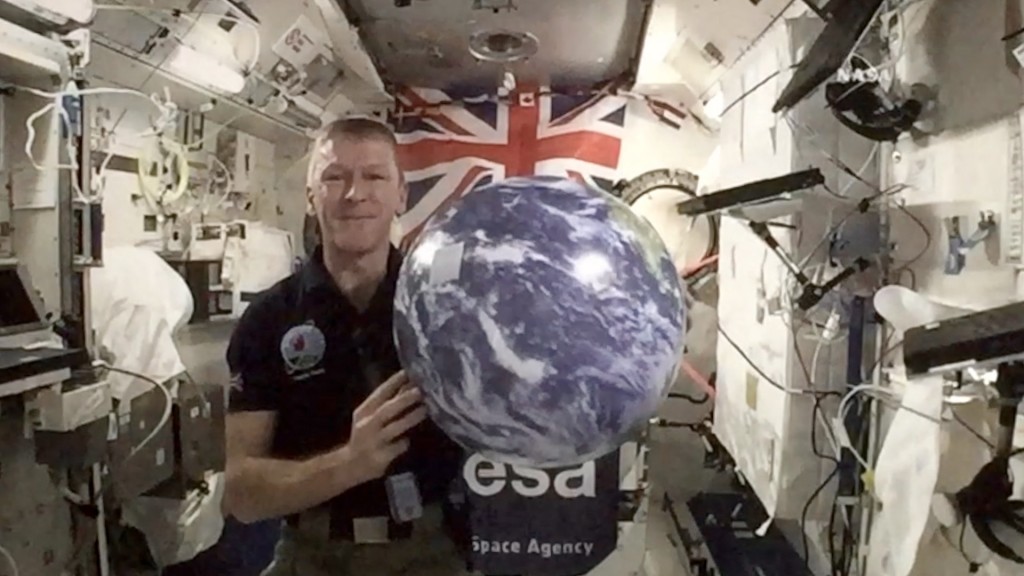
Astronaut Tim Peake's live TES #CosmicClassroom thrills hundreds of thousands of school pupils


http://ynuk.tv/wp-content/uploads/2016/02/Tim-explains-gravity-on-ISS-e1454466764846.jpg
British astronaut Tim Peake inspired hundreds of thousands of school pupils today as he spoke to them live from the International Space Station.
“Just do what you really enjoy doing,” Major Peake told students as he demonstrated how serious science could also be lots of fun.
During the 20-minute lesson,  Major Peake crouched down, spun around and touched his toes in order to demonstrate that without gravity it is much harder to stop moving and much easier to do somersaults.
 “We are so privileged to get to work up here,” he said. “It is like playing in a playground of weightlessness.”
Major Peake also answered some of the 7,000 questions which were submitted by school children, including whether his heart was beating faster (it actually beats slower because it has to work less hard), what his favourite button was (the one which opens the air lock to outer space) and whether it was fun to drink water bubbles (yes, a lot of fun). Tim Peake explained that the space station was hit all the time by small particles, but if anything larger was spotted the craft moved course.
At the World Museum in Liverpool, pupils from 12 schools around Britain took part in workshops ranging from "training like an astronaut" to modelling planets.
After the workshops, the pupils gathered to watch Kevin Fong – space medicine scientist and television personality – host the live link-up on a giant screen.
Dr Fong told TES why he thought space held such a fascination for children. “Space is about their future,” he said. “It gives them a sense that anything is possible, which is really what you want to encourage children to think.”
The Cosmic Classroom was watched by an estimated 300,000 students, in more than 10,000 schools.  Schools in the USA, Australia, the Philippines, Egypt, India, Pakistan and China were among those registered. But no registration was required to watch the broadcast, which was open to all.

Question 1 (2 points)  Indicate whether the following statements are true or false and write down which part of the text justifies your answer.
a.  Tim Peake went to visit students in British schools today.
b.  It is difficult to keep still in space.
c.   All the students at the World Museum were from schools in Liverpool.
d.   Everyone could watch the Cosmic Classroom for free.

Question 2 (2 points)  Answer the following questions in your own words.
a.   What were Major Peake’s answers to the questions about his heart and the water bubbles?
b.   Who is Dr Kevin Fong?

Question 3 (1·5 points)  Find words or phrases in the text that correspond in meaning to the words and definitions given.
a.  turn round very fast  (para. 3)  b. see (para.5)  c.  change direction (para. 5)
d. huge  (para. 7)   e.  show, programme (para. 9)

Question 4   (1·5 points)  Complete the following sentences without changing the meaning.
a. “Space is about their future,” Kevin Fong said. “It gives them a sense that anything is possible, which is really what you want to encourage children to think.”
Kevin Fong said that ……
b. British astronaut Tim Peake inspired hundreds of thousands of school pupils today.
Hundreds of thousands………….
c. The Cosmic Classroom was watched by an estimated 300,000 students, in more than 10,000 schools.
An estimated …

Question 5  (3 points)  Write a short essay (120-150 words) on the following topic:
Nowadays, we can learn in very different ways to the ways our parents did.

Fishermen mistook part of lost American rocket part for whale

Scilly Isles fishermen mistook the lost piece of an American rocket which exploded minutes after take-off at Florida for a whale.
Joseph Thomas, from Tresco Boat Services, found the section of rocket while travelling around the north end of the island.  He said: "There were lots of gulls on the water and I thought initially it was a dead whale and the birds were feeding off it."  "First thoughts, were that it was part of a plane, but then we scraped the barnacles off and we saw it was part of a rocket.” he added.
The large piece of metal, believed to be from the SpaceX Falcon-9, had travelled over 4,000 miles across the Atlantic.
Fisherman Pete Hicks, who helped carry the piece to land, said: "My friend found the object and thought it was a dead whale.  "He was unable to pull it ashore so we went out and used a crane to tow it in. "It was covered in barnacles. It was only when we got it ashore and they cleared them away that we saw the USA flag and realised what it was. It was light but very strong.  We get all sorts of things washed up but this is very rare."
Martin Leslie, coastal area commander for the coastguard, said: "It seems most likely to be the unmanned SpaceX Falcon-9.” The rocket was destined for the International Space Station and its explosion in Florida cost NASA a reported $110m worth of equipment and supplies.
The 10m x 4m chunk is currently being held on the island. The debris has appeared five months after the incident. Coastguards issued a warning to shipping in the area after the discovery.
Martin Leslie praised the work of the fishermen and lifeguards.   "We're grateful for all those who helped in its recovery - it was a great example of the community working together."

Question 1 (2 points) Indicate whether the following statements are true or false and write down which part of the text justifies your answer.

a. The rocket fell off a plane.
b. The rocket was seen by the man from the shore.
c. They think almost for sure that it is part of a known rocket.
d. The piece has been taken back to the NASA headquarters.

Question 2 (2 points) Answer the following questions in your own words.
a. How did the man narrate the finding of the rocket?
b. What did they do with the rocket?

Question 3 (1.5 points) Find words or phrases in the text that correspond in meaning to the words and definitions given.

a. onto land par 4                   b. goods par 5            c Piece par 6
d.) to applaude par 7              e. rescuers par 7

Question 4 (1.5 points) Complete the following sentences without changing the meaning.
a. Scilly Isles fishermen mistook the lost piece of an American rocket  for a whale.
The lost ……………..
b. “We're grateful for all those who helped in its recovery”, he said.
He said that………
c. It seems most likely to be the unmanned SpaceX Falcon-9.
It seems it ……………………………………..

Question 5 (3 points) Write a short essay (120-150 words) on the following topic:

Do you keep the things you do not need? Have  you ever thought of selling them? 

Why your $8 shirt is a huge problem

To give you some ideas for your essay, you could watch this video about having too many clothes and the damage they cause to the environment.


Modal verbs

Rewrite the sentences using a modal verb.

1. It isn’t necessary for you to take a jacket.

2. I advise you to see a dentist.

3. You aren’t allowed to talk during the exam.

4. It’s forbidden to park here.

5. I advise you to study harder.

6. He is obliged to go to the police station twice a week.

7. Tom knows how to speak Spanish.

8. He had permission to go to the party.

9. It isn’t possible that that is our plane.

10. It isn’t necessary to take a thick coat.

11. I wish I had paid for half of the meal, but I didn’t.

12. It was wrong of Mary to tell Steve about us.

13. Perhaps Anita didn’t get the text message.

14. It’s possible that they went to the cinema.

15. It wasn’t a good idea to ask the other couple to come with us.

16. I am certain you haven’t seen John because he is on a trip.
 You…
17. It is possible that Jake is in his room.
 Jake…
18. Perhaps we will not see them at the weekend.
 We…
19. I don’t know if I will go to the concert.
 I…
20. They are certain that bringing up children is not easy.
 Bringing up children…
21. It is unnecessary for you to come.
 You…
22. I advise him to give up smoking.
 He…
23. Eating chewing-gum in the class in prohibited.
 Students…
24. There was an obligation to turn off the mobile phone.
 We…
25. I didn’t have the ability to cook when I was younger.

I…


Key
  1. You needn’t / don’t have to take a jacket.
  2. You should see a dentist.
  3. You must talk during the exam.
  4.  You mustn’t park here.
  5. You should study harder.
  6. He must go to the police station twice a week.
  7. Tom can speak Spanish.
  8. He could / was allowed to go to the party.
  9. That can’t be our plane our plane.
  10. You needn’t / don’t have to take a thick coat.
  11. I should have paid for half of the meal, but I didn’t.
  12. Mary shouldn’t have told Steve about us.
  13. Anita may not have got the text message.
  14. They may have gone to the cinema.
  15. You shouldn’t have asked the other couple to come with us.
  16. You can’t have seen John because he is on a trip.
  17. Jake may be in his room.
  18. We may not see them at the weekend.
  19. I may not go to the concert.
  20. Bringing up children can’t be easy.
  21. You needn’t / don’t have to come.
  22. He should give up smoking.
  23. Students mustn’t eat chewing-gum in the class.
  24. We must turn off the mobile phone.
  25. I couldn’t cook when I was younger.

Key: Astronaut Tim Peake's live TES #CosmicClassroom thrills hundreds of thousands of school pupils

Question 1
a.  False. British astronaut Tim Peake inspired hundreds of thousands of school pupils today as he spoke to them live from the International Space Station.
b.  True.     without gravity it is much harder to stop moving
c.  False.   At the World Museum in Liverpool, pupils from 12 schools around Britain took part in workshops…
d.  True. no registration was required to watch the broadcast, which was open to all.

Question 2   
a.  He said that his heart pumps less quickly because it does not have to make such an effort and that he really enjoyed drinking water bubbles.
b.   Dr Fong is a famous person who appears on TV and is also an expert in space medicine.
 
Question 3    a.  spin/spun   b.  spot/spotted   c. move/moved course   d.  giant   e.  broadcast

Question 4
a.  Kevin Fong said that Space was about their future. It gave them a sense that anything was/is possible, which was really what you wanted to encourage children to think.
b. Hundreds of thousands of school pupils were inspired today by British astronaut Tim Peake.

c.  An estimated 300,000 students, in more than 10,000 schools watched The Cosmic Classroom.

Fishermen mistook part of lost American rocket part for whale

Question 1
            a) FALSE “the lost piece of an American rocket which exploded minutes after take-off”
            b) FALSE “Joseph Thomas, from Tresco Boat Services, found the section of rocket while travelling around the north end of the island”
            c) TRUE "It seems most likely to be the unmanned SpaceX Falcon-9.”
            d) FALSE The 10m x 4m chunk is currently being held on the island”
Question 2
            a) He saw many gulls, which he thought were eating a dead animal. However, after they cleaned it up, what appeared to be a part of a plane was the rocket.
            b) They used a crane to take it from the sea to the shore where they cleaned all the barnacles on it. Now the rocket is kept on the island.

Question 3
a)    ashore
b)    supplies
c)    chunk
d)    praise
e)    lifeguards

Question 4
a)    The lost piece of an American rocket was mistaken for a whale by Scilly Isles fishermen.
b)    He said that they had been grateful for all those who had helped in its recovery.

c)    It seems it may/might/could be the unmanned SpaceX Falcon-9.