martes, 20 de noviembre de 2012

New baby boom to put 'enormous' strain on NHS


Key

Question 1
a)       False. Midwives are warning that the trend is continuing and will swell births to more than 700,000 in England this year - the first time that level has been reached since 1971
b)       False. Today’s midwives simply have never seen anything like it.
c)       False. Some NHS trusts are reducing vacancies, meaning a sixth of new midwives have been looking for a job for more than three months.
d)       True. Dr Dan Poulter, the health minister, yesterday announced at extra £25 million would be spent on maternity wards to build ensuite facilities, rooms for partners to stay overnight and birthing pools.

Question 2
a)       The main reason that the number of births is rising is that people are coming to live in the UK from abroad.
b)       New additions to buildings will provide bathrooms for rooms, rooms for father to sleep in and swimming pools where mothers can give birth.

Question 3
a)  rate(s)    b)  clear    c)  albeit

Question 4
a) The main reason for the rise in birth rates is immigration.
b)
Cathy Warwick said that today’s midwives simply had never seen anything like it and that she really believed that they were at the limit of what maternity services could safely deliver.
c)
Midwife numbers could actually fall in some places due to cost-cutting.
If cost are cut, then midwife numbers could actually fall in some places.

martes, 6 de noviembre de 2012

Britons want manners taught in school, poll finds

Three in four people believe manners should be taught in school, a new survey has found.

A survey by supermarket Waitrose found that good manners are slipping with 72 per cent of those polled saying people have become more rude over the last decade. The poll was conducted to mark the launch of the book How Rude! Modern Manners Defined, which will be published on Tuesday.

More than 70 per cent of respondents thought that good manners should be taught in school as part of the national curriculum It used to be the teaching of the three Rs that was considered the mainstay of a good school education, but the poll found that today most people would prefer the four Rs - reading, writing, arithmetic and respect.

Failing to say 'please' or 'thank you' was considered the most irritating example of bad manners. It irks people in Northern Ireland the most, as nearly 60 per cent of them cited it as the most irritating example of bad manners, compared with the national average of nearly 40 per cent.

Although In Europe, a kiss on the cheek is de rigueur when greeting friends, the survey shows keeping each other at arm's length is the preferred option of Brits. When asked the most appropriate greeting in a social situation more than 50 per cent felt a handshake did the job rather than kisses on the cheek or an embrace.

Women are the most keen to keep friends and acquaintances at arm's length, with a quarter of the women polled (25 per cent) feeling no physical contact was necessary with a simple hello being enough, compared to only 12 per cent of men.

More than 60 per cent of those surveyed blamed parents for the deterioration in good manners. This caused debate between the generations as only 43 per cent of 18 to 24-year-olds blamed the parents, compared with 76 per cent of the over 55s.

On the plus side, respecting your elders appears to be alive and well as nearly 60 per cent claimed to give up seats to the elderly on public transport, although nearly one in four people avoid eye contact all together when travelling on public transport.

Question 1. Indicate whether these sentences are true or false. Justify your answers with evidence from the text.
a) The number of rude people in the UK has recently increased.
b) British people like being close to each other when they meet
c) Changes in the educational system are considered the reason why people are losing manners.
d) People are still polite to old people.

Question 2. Answer the following questions in your own words.
a) What is the difference between the UK and Europe in terms of greetings?
b) What is the preferred education system for the people interviewed?

Question 3. Find a word or a phrase in the text that means the same as:

a) starting point par 2
b) to annoy, bother par 3
c) relations par 5

Question 4. Rewrite the following sentences without changing the meaning.

a) Although In Europe, a kiss on the cheek is de rigueur when greeting friends, the survey shows keeping each other at arm's length is the preferred option of Brits.
In Europe, a kiss on the cheek is de rigueur when greeting friends, …………………………
b) More than 60 per cent of those surveyed blamed parents for the deterioration in good manners
Parents ……………………………………….
c) The poll was conducted because they are launching a book.
If they were............

Question 5. Write a short essay (120-150 words) on the following topic:

Do you think manners are disappearing nowadays? Why? Why not?


Rephrasings 1

Rewrite the following sentences without changing the meaning.


1. “Why don’t we play computer games?” said Michael.

Michael suggested ……………………

2. Molly said: “Are you coming to the party on Friday?”

Molly asked him ………………………….

3. They came to live in New York two years ago.

They have ………………………………………..

4. Smoking is forbidden in hospitals.

You ……………………………….

5. Although the weather was horrible, we went skiing.

In spite of …………………………………

6. I would like to have more free time these days.

I wish ……………………………………………

7. I met that famous writer a year ago.

It’s been a year …………………………

8. Wendy didn’t study for her test. Therefore, she failed.

If ………………………..

9. “Don’t speak so loud, please”, the teacher said to the students.

She ……………………………..

10. My new neighbours have got a baby. Her name is Claire.

My……………………………………………..


KEY

1. Michael suggested playing computer games.

2. Molly asked him if he was going to the party the following Friday.

3. They have been living in New York for two years.

4. You mustn’t smoke in hospital. You are not allowed to smoke in hospitals

5. In spite of the horrible weather, we went skiing.

6. I wish I had more free time these days.

7. It’s been a year since I met a famous writer.

8. If Wendy had studied for her test, she would not have failed.

9. The teacher asked the students not to speak so loud.

10. My neighbours have got a baby whose name is Claire

More animals are abandoned


The RSPCA say they're at crisis point because of a rise in the number of animals being abandoned.

The animal charity say 40,000 pets were abandoned last year, compared to just 25,000 five years ago.

It thinks families struggling with money problems are leaving their pets because they can't afford to look after them.

Charities that run rescue centres say they are getting full and not enough people are coming forward to adopt.

The cost of caring for abandoned animals is also going up. It costs £15 a day to care for a dog and £9.40 for a cat.

Because some animals are unwell when they come to rescue centres, it can take a long time to look after them and make sure they're well enough to be rehomed.

The RSPCA say they might be forced to turn away vulnerable animals in the future because of the crisis.

Match the words below to their definitions
  
abandoned / afford / crisis / charities / rescue / struggling 
  1. situation that is extremely dangerous or difficult
  2. have enough money to buy or do something
  3. organisations that give money, food or help where it is needed
  4. trying very hard to do something difficult
  5. left someone or something somewhere without ever coming back for them
  6. save someone from a dangerous or unpleasant situation  
True or false?
  
1. It costs more to look after a dog than a cat.
2. The number of abandoned animals is increasing.
3. No abandoned animals ever go to new homes.
4. The RSPCA will never turn away animals.
5. The RSPCA also treats sick animals.
6. All of the abandoned pets are dogs.
7. The RSPCA is having problems.
8. Animals can’t go to new homes if they are not well enough.
What's the missing word?
  
1. It thinks____________________struggling with money problems are leaving their pets.
2. The cost of_______________for abandoned animals is also going up.
3. They might be_________________to turn away vulnerable animals.
4. Not enough people are coming forward to_______________.
KEY
crisis              situation that is extremely dangerous or difficult
afford             have enough money to buy or do something
charities          organisations that give money, food or help where it is needed
struggling         trying very hard to do something difficult
abandoned      left someone or something somewhere without ever coming back for them
rescue             save someone from a dangerous or unpleasant situation  
True or false?
1. False
2. True
3. False
4. False
5. True
6. False
7. True
8. True

What's the missing word?
1. families
2. caring
3. forced
4. adopt

Dolphins can 'stay awake for 15 days', says US study


Dolphins can stay awake for 15 days or more - by sleeping with one half of their brain at a time, scientists have learned.

Researchers in America tested two bottlenose dolphins' responses to echoes as they swam around a pen.
 
The mammals kept going for five days non-stop in three separate tests, and one even managed 15 days in another trial.
 
Experts think the ability is an important survival skill for dolphins. It means they can surface to breathe when they need to and keep watch for shark attacks.
 
Dolphins use sound waves to find their way, hunt prey, detect predators and organise groups.
 
 
Match the words below to their definitions
 
echoes / mammals / predators / responses / surface / survival
 
  1. reactions to something
  2. when sound reflects off something and you hear it again
  3. animals that produce milk to feed their babies
  4. when someone or something continues to live or exist, especially after a difficult or dangerous situation
  5. rise to the top of a body of water
  6. animals that kill and eats other animals
 True or false?
 
1. There are two halves to a dolphin brain.
2. Dolphins can’t remain awake for long periods of time.
3. Dolphins always stay awake for 15 days.
4. Dolphins hunt other animals.
5. The researchers studied dolphins in the wild.
6. Sound waves help dolphins navigate.
7. Experts don’t know why dolphins stay awake so long.
8. Sharks sometimes attack dolphins.
 
 What's the missing word?
 
 1. Researchers in America____________________two bottlenose dolphins' responses.
 2. One even_______________15 days in another trial.
 3. Experts think the_________________is an important survival skill.
 4. It means they can surface to________________when they need to.


KEY
 
responses: reactions to something
echoes: when sound reflects off something and you hear it again
mammals: animals that produce milk to feed their babies
survival: when someone or something continues to live or exist, especially after a difficult or dangerous situation
surface: rise to the top of a body of water
predators: animals that kill and eats other animals
 
 True or false?
 
1. True
2. False
3. False
4. True
5. False
6. Truee
7. False
8. True
 
 What's the missing word?
 
1. tested
2. managed
3. ability
4. breathe


Britons want manners taught in school, poll finds

Key


Question 1

a) TRUE: good manners are slipping with 72 per cent of those polled saying people have become more rude over the last decade

b) FALSE: when greeting friends, the survey shows keeping each other at arm's length is the preferred option of Brits

c) FALSE: More than 60 per cent of those surveyed blamed parents for the deterioration in good manners

d) TRUE: respecting your elders appears to be alive and well as nearly 60 per cent claimed to give up seats to the elderly on public transport)


Question 2

a) People in Europe consider a kiss in the cheek almost as a compulsory sign of good manners whereas British people keep a distance with other people or prefer just to shake hands rather then embracing.

b) Most of the people interviewed prefer a system which inclues what they call the four Rs, which means reading, arithmetic, writing but also respect.


Question 3

a) starting point, basis mainstay

b) to annoy, bother irk

c) relations acquaintances


Question 4

a) In Europe, a kiss on the cheek is de rigueur when greeting friends, In spite of the fact that the survey shows keeping each other at arm's length is the preferred option of Brits.

b) Parents were blamed for the deterioration in good manners by more than 60 per cent of those surveyed

c) If they were not launching a book, they wouldn't have conducted a poll.

martes, 23 de octubre de 2012

French phone company rings up a bill of €11,721,000,000,000,000

It was surely the most astronomical phone bill in history. When an unemployed childminder in south-west France received a bill for €11,721,000,000,000,000 (that's 11.7 million billion euros – more than 5,000 times the gross domestic product of France) – it took her days of wrangling with helpline staff to stop it being debited from her bank account.

Solenne San Jose. of Pessac, a Bordeaux suburb, had just lost her job and wanted to end her phone subscription, when the final bill arrived. She told her local paper, Sud Ouest: "I nearly had a heart attack. There were so many zeros that I couldn't even work out how much it was."

She called Bouygues Telecom, the phone company headed by Martin Bouygues, a friend of Nicolas Sarkozy, but was told by shrugging staff there was nothing they could do. One said: "It's calculated automatically." Another told her she would be contacted about paying in instalments. Several calls later, an adviser admitted it was a mistake: San Jose owed €117.21. The company has apologised and let her off the real bill.

guardian.co.uk, Thursday 11 October 2012

Complete Solenne’s story:

“I lost my job, and was going to end my (1) p………….. subscription. One day, when I was checking the post, I opened an envelope and found a telephone (2) b ……. .

I nearly had a (3) h……………. a…………… ! There were so many (4) z……….. , I couldn’t even calculate how much the total was!

Later that day, I telephoned Bouygues Telecom, but they were really unhelpful! I spoke to several members of (5) s……….. at the company, and all they told me was that ‘the bill was (6) c……………. automatically.’

Another employee told me that the only solution would be to pay the bill in
(7) i ……………... ! I panicked! I had no job and no money to pay anything!

Finally, one day, after numerous phone (8) c ……….. , someone at the company told me that the bill was a (9) m ……………….. .. Instead of owing 11.7 million euros, I actually owed 117.21! Although the company has (10 ) a………………….. and said I don’t need to pay them anything now, it doesn’t really make up for all the stress I’ve suffered.”


Key

1 phone 2 bill 3 heart attack 4 zeros 5 staff 6 calculated 7 instalments 8 calls 9 mistake 10 apologised


VIDEO LISTENING
London 2012: What next for the Olympic Park?

The marathon task of dismantling several sporting venues at the Olympic Park in London is about to begin.

The park is the size of over 350 football pitches with 200,000 temporary seats in it.


BEFORE YOU WATCH

Match the words below to their definitions to help you understand the video

apprentice / cauldron / extinguished / festival / harness / imperceptibly / legacy /

navigating / promenade / punctuation / radically / transformation / volunteer

a. organized set of special events
b. something, usually of value, that is handed down to the future
c. large pot, usually made of metal
d. put out a fire or turned off a light
e. describes an action that isn’t noticed or felt because it is very small or slow
f. paths made for walking
g. complete change in the appearance or character of something or someone
h. planning and then following a route
i. describes an action that is extreme or completely different
j. control something in order to use its power
k. marks, such as full stops, commas, and brackets, used in writing to separate sentences and their elements, and to clarify meaning
l. someone who has agreed to work for a skilled person, often for low pay, in order to learn that person's skills
m. person who does something, especially helping other people, willingly and without being forced or paid to do it


Same or different?

1. altogether

a) the same as simultaneously
b) the same as partially
c) the same as completely

2. acquire

a) the same as gain
b) the same as forfeit
c) the same as acquiesce

3. dismantled

a) the same as raised
b) the same as disassembled
c) the same as subverted

4. eventually

a) the same as henceforth
b) the same as subsequently
c) the same as ultimately

AFTER YOU WATCH

True or false?

1. Over four million people have already visited the Olympic Park.
2. Some of the venues will change substantially once the Olympics is over.
3. This weekend is not expected to be as busy as previous ones.
4. The aquatic arena will remain unchanged.
5. The main stadium will be sold after the Olympics has finished.
6. The riverbank arenas are only temporary structures.
7. The basketball arena can’t be reused.
8. David Stubbs says that the Olympic Park will serve no useful purpose in future.
9. The transformation of the park will be completed by next summer.
10. Some volunteers will be unemployed after the Olympics is over.

What's the missing word?

1. Slowly, imperceptibly as far as the crowds are_________________, the curtain is coming down.
2. Around the packed promenades, a transformation_________________.
3. It will remain a key__________________for athletics.
4. Many of his____________________will find it hard to return to life outside the Games.


KEY

1. festival: organized set of special events
2. legacy: something, usually of value, that is handed down to the future
3. cauldron: large pot, usually made of metal
4. extinguished: put out a fire or turned off a light
5. imperceptibly: describes an action that isn’t noticed or felt because it is very small or slow
6. promenades: paths made for walking
7. transformation: complete change in the appearance or character of something or someone
8. navigating: planning and then following a route
9. radically: describes an action that is extreme or completely different
10. harness: control something in order to use its power
11. punctuation: marks, such as full stops, commas, and brackets, used in writing to separate sentences and their elements, and to clarify meaning
12. apprentice: someone who has agreed to work for a skilled person, often for low pay, in order to learn that person's skills
13. volunteer: person who does something, especially helping other people, willingly and without being forced or paid to do it

Same or different?
completely
gain
disassembled
ultimately

True or false?

1. False
2. True
3. False
4. False
5. True
6. True
7. False
8. False
9. False
10. True

What's the missing word?

1. concerned
2. awaits
3. venue
4. colleagues


Mice 'can sing in harmony' like humans and birds


Mice may be able to learn to 'sing' in harmony like humans and some birds, according to US scientists.
 
Male mice sing complex songs to attract females, but it's long been thought they couldn't control their pitch, how high or low it sounds.
 
Duke University researchers have now found that when male mice were housed together, they changed the pitch of their songs to match each other. But some scientists aren't so sure the evidence supports the new finding.
 
The melodies that mice make are ultrasonic, so they're too high-pitched for human ears. Only a few animals are able to adapt the pitch of their sounds - something known as "vocal learning". Creatures with this talent include parrots, whales, dolphins, bats and elephants.
 
Match the words below to their definitions
 
complex / evidence / harmony / researchers / ultrasonic / vocal
 
  1. pleasant musical sound
  2. involving lots of things and difficult to understand
  3. people who study something to learn new things
  4. something that makes you believe that something is true
  5. very high-pitched sound that you can’t hear
  6. involving or relating to your voice
 True or false?
 
 1. The study focused on male mice.
 2. Not all scientists agree with the study.
 3. Mice are the only animals that can sing.
 4. Humans can’t hear the mouse songs.
 5. Male mice can’t sing in harmony.
 6. Parrots and dolphins can’t sing.
 7. The mice raise and lower their voices.
 8. Duke University in the United States.
 
 What's the missing word?
 
1. The________________that mice make are ultrasonic.
 2. Only a few animals are able to_____________the pitch of their sounds.
 3. Male mice sing complex songs to______________females.
 4. It's long been thought they couldn't________________their pitch.


KEY
 
Match the words below to their definitions

harmony: pleasant musical sound
complex: involving lots of things and difficult to understand
researchers: people who study something to learn new things
evidence: something that makes you believe that something is true
ultrasonic: very high-pitched sound that you can’t hear
vocal: involving or relating to your voice
 
 True or false?
 
1. True 
2. True
3. False
4. True
5. False
6. False
7. True
8. True
 
What's the missing word?
 1. melodies
 2. adapt
 3. attract
 4. control

New dinosaur that's part bird, vampire bat and porcupine discovered!


A new kind of dinosaur has been identified that is part parrot, part vampire bat and part porcupine.

Scientists say the scary looking beast is called Pegomastax africanus, which means "thick jaw from Africa".

The dinosaur had a parrot-like beak, porcupine-like spikes and sharp fangs, which is unusual because they also think it was a vegetarian!

Experts from the University of Chicago sayPegomastax africanus was identified from fossils found in South Africa. It was about the size of a pet cat and lived 100-200 million years ago.

Professor Paul Sereno, from the University of Chicago, actually first discovered the creature way back in 1983.

But he got distracted by other work and didn't get round to writing about it until now!


Match the words below to their definitions

creature / discovered / fangs / fossils / porcupine / vampire bat

1. small flying animal that sucks blood from other animals
2. type of animal that is covered with large stiff hairs which protect it
3. long sharp teeth
4. ancient plants or animals that have been turned into stone
5. found something for the first time
6. animal

True or false?

1. The dinosaur was small and spiky.
2. Paul Sereno only discovered the dinosaur recently.
3. The dinosaur was found in Chicago.
4. The dinosaur was related to pet cats.
5. The dinosaur looked like a parrot.
6. The dinosaur died in 1983.
7. There are no fossils in South Africa.
8. Pegomastax africanus has a heavy jaw.

What's the missing word?

1. Pegomastax africanus was ____________ from fossils found in South Africa.
2. The dinosaur had a parrot-like ____________ .
3. The ____________ looking beast is called Pegomastax africanus.
4. But he got ____________ by other work.


KEY

Match the words

vampire bat: small flying animal that sucks blood from other animals
porcupine: type of animal that is covered with large stiff hairs which protect it
fangs: long sharp teeth
fossils: ancient plants or animals that have been turned into stone
discovered: found something for the first time
creature: animal

True or false?

1. True
2. False
3. False
4. False
5. True
6. False
7. False
8. True

What's the missing word?

1. identified
2. beak
3. scary
4. distracted

martes, 9 de octubre de 2012

Back to school


Are you ready for the new school year?

We think we are, so keep an eye on the blog as the new activities are on their way!


lunes, 23 de julio de 2012

Do you recognise this place?
Clues....
It's in London.
It's on the south bank of the River Thames.
You can see London from above.
It's .....
the London Eye!

Ane who is the woman on the top of the London Eye?


Amelia Hempleman-Adams took the torch on a trip on the giant observation wheel on the south side of the River Thames on Sunday, riding atop one of the Eye's viewing capsules as it slowing rotated.
The 17-year-old Hempleman-Adams was the youngest person to ski to the South Pole last year.


You can watch Amelia Hempleman-Adams climbing up to the top of the London Eye capsule here:
http://www.guardian.co.uk/sport/video/2012/jul/22/olympic-torch-london-eye-video


So what more can we expect over the summer from the Olympics?
The games will be officially opened on Friday, 27th July.

London 2012 Olympic Games Opening Ceremony

Must See!
Dates:27 July 2012
Times:9pm
Venue:2012 Olympic Park and Village
Prepare for one of the greatest shows on earth as the London 2012 Olympic Games Opening Ceremony finally arrives.

London 2012 Olympic Opening Ceremony

The eyes of the world will be on London on 27 July for the Opening Ceremony of the Olympic Games, which is expected to have a global TV audience of more than a billion people.
Award-winning film directors Danny Boyle (Trainspotting, The Beach and Slumdog Millionaire) and Stephen Daldry (Billy Elliot) will oversee what is sure to be the UK's biggest-ever live show.

British Countryside Comes to the Olympic Stadium

The Olympic Stadium will be transformed into a British countryside scene for the Opening Ceremony.
The set – one of the largest ever built – will feature meadows, fields and rivers, families eating picnics, sports being played on the village green and real farmyard animals, including 70 sheep.
Titled "Isle of Wonder", the event will open with the ringing of the largest harmonically tuned bell in the world..
(Actor Mark Rylance was due to feature in the Olympic Opening Ceremony but has withdrawn for personal reasons. He is still expected to appear at Shakespeare's Globe this summer.)

Olympic Ceremony Athletes' Parade

Don't miss the chance to see your favourite athletes in the Olympic Ceremony Athletes' Parade.
The Olympic Opening Ceremony parade will feature 10,000 athletes from 205 nations.
Each country has its moment of glory however many (or few) athletes it has competing. Cheer on your country's entrants as they take a lap of the Olympic Stadium's running track proudly holding aloft their national flag.
Then, there will be events every day till the Closing Ceremony on August 12th.
Let's hope the Olympics are a fun, successful event!


Moving around in London

martes, 17 de abril de 2012

Especial PAU

Question 1

Question 1 [2 points]
Indicate whether the following statements are true or false and write down which part of the text justifies your answer.


En primer lugar, recuerda que tu respuesta debe de ser TRUE, FALSE, con la palabra completa y por supuesto en inglés. Cuando copies del texto para justificar tu respuesta, limita la cita copiando solamente la información necesaria, que si bien debe de recoger las respuestas a todas las partes de la pregunta, no debes incluir información extra, ya que esto conlleva una penalización.


Tienes que tener en cuenta que en algunas ocasiones la justificaciĂłn a la frase dada puede estar en dos partes, incluso en distinto pĂĄrrafo. Debes incluir toda la informaciĂłn, para ello puedes utilizar dos citas separadas.

Todas las partes de la frase tienen que ser “verdaderas”. Si cualquiera de las partes de la frase es falsa, toda la frase es falsa aunque muchas de las otras sean verdaderas.

Presta mucha atenciĂłn a las partĂ­culas negativas, calificadores, intensificadores, o sucesiones de frases muy largas.

Las negativas pueden confundirte. Si la pregunta contiene negativas, tales como “no, not, cannot”, elimina la negativa y lee lo que te queda. Decide si la frase es verdadera o falsa. Si es verdadera, normalmente, su negativa es falsa.


Fíjate bien si en la frase aparece un modal que indique posibilidad o certeza y que en el texto se refleje también esa posibilidad, para que esa frase sea verdadera, si la pregunta da una posibilidad que en el texto aparece como algo seguro, evidentemente la frase es falsa.

Los calificadores son palabras que limitan o amplian frases generalistas.
Palabras como “sometimes, often, ordinarily, generally” amplian las posibilidades de hacer las frases mĂĄs exactas. Hacen las afirmaciones mĂĄs modestas, mĂĄs parecidas a la realidad, y normalmente son respuestas “verdaderas”.

Las palabras “absolutas” limitan las posibilidades.
“no, never, none, always, every, entirely, only” implican que la frase debe ser totalmente verdadera todo el tiempo y normalmente indican respuestas “falsas”

Las frases largas a menudo incluyen grupos de palabras separadas por algĂșn signo de puntuaciĂłn. Presta atenciĂłn a la “verdad” de cada una de sus partes. Si una de ellas es falsa, entonces normalmente indica que la respuesta es “falsa”

Ejemplo:
La pregunta que te hacen es la siguiente:

Once Laura has achieved her goal, there will be no more objections from the Dutch government organisations.

AquĂ­ tienes que justificar que Laura ha alcanzado su objetivo y que el gobierno no pondrĂĄ mĂĄs objeciones.
En el texto esta informaciĂłn aparece en el Ășltimo pĂĄrrafo:

"Now, after sailing around the world, with difficult port approaches, storms, dangerous reefs, and the full responsibility of keeping myself and Guppy safe, I feel that the nightmares the Dutch government organisations put me through, were totally unfair," Miss Dekker wrote.I hear now that the Dutch government organisations have started causing problems again. I am seriously thinking about not returning to the Netherlands.”

Y la justificaciĂłn serĂ­a la siguiente:

“Now, after sailing around the world ........ .I hear now that the Dutch government organisations have started causing problems again.”

Como ves, la información que damos viene en dos partes separadas del pårrafo y no lo hemos copiado todo entero, ya que nos penalizarían porque estaríamos añadiendo datos que no son necesarios.

Question 2

Question 2 [2 points]
Answer the following questions in your own words.

1. Lee la pregunta y fĂ­jate bien en el tipo de informaciĂłn que te piden: razones, lugar, momento… . Fijate bien en los pronombres interrogativos (why, where, when,,, ) A veces la informaciĂłn que se pide es doble, por ejemplo, what and where…..?

2. Utiliza palabras clave o sus sinĂłnimos para ayudarte a localizar la respuesta en el texto. (Los nombres, verbos y adjetivos suelen ser las palabras clave)

3. FĂ­jate bien en el tiempo verbal en el que se te hace la pregunta ya que la respuesta serĂĄ en ese mismo tiempo.

4. Escribe la respuesta con tus propias palabras en la medida que te sea posible, si has utilizado alguna palabra del texto, cåmbiala por un sinónimo. No añadas información innecesaria, ni tampoco des tu opinión, la opinión la tienes que reflejar en question 5.

5. Comprueba la ortografĂ­a y la puntuaciĂłn asĂ­ como el tiempo verbal y el vocabulario.

Ejemplo: Where have they done the research? What technique did they use?

Fíjate que en esta pregunta tienes que responder por el lugar y ademås por la técnica utilizada para hacer esta investigación.

Respuesta: They have done the research in the USA. They used a technique called “focused attention“, which makes the people’s mind concentrate on their breathing while they meditate.


Por tanto la primera parte de la respuesta incluye el lugar y en el mismo tiempo verbal en que va dicha pregunta.

En cambio en la segunda parte cambiamos el tiempo verbal para dar respuesta a la segunda informaciĂłn que nos pedĂ­an, ya que esta pregunta utiliza el pasado simple.

Question 3


Impington Village College pupil Chris Whitehead wears a skirt in protest at his school's policy of making boys wear long trousers in the summer.
Chris Whitehead wore a skirt to classes at Impington Village College, near Cambridge, Cambs. He is protesting against the school uniform policy.
Chris believes that forcing boys to wear long trousers during the sizzling summer months affects concentration and their ability to learn. He said: ''In the summer girl students are allowed to wear skirts but boys are not allowed to wear shorts. We think that this discriminates against boys. I will march in a skirt with other boys waving banners and making a lot of noise. I will be wearing the skirt at school all day in protest at the uniform policy and addressing the assembly with the student council, wearing a skirt.''
Chris's mum Liz Whitehead, 50, has praised her son. She said: ''I am delighted that Chris is taking action on what he believes in.
I am really proud he is brave enough to wear a skirt to school for what he believes in and back him all the way.''
The ban on shorts was imposed following consultation with students, teachers and parents in 2009. But when Chris joined the school he was outraged by the policy and pledged to overturn the decision.
Headteacher Robert Campbell said: ''Our uniform policy had a significant consultation and ours is typical of most schools in Cambridgeshire and the consensus was we were going to go for that. ''Chris is one of our brightest and most articulate students and we have got a very strong student council. He is one of only two year 8 pupils on it.”

Question 3
Find words or phrases in the text that correspond to the words or definitions given.
** Consejo: Las palabras que vas a encontrar en esta parte de la prueba estĂĄn siempre en el mismo orden en el que aparecen en la pregunta; si hay que encontrar 2 palabras en el pĂĄrrafo 2, por ejemplo, la primera palabra que tienes que encontrar aparecerĂĄ antes que la segunda.
1. to make someone do something (paragraph 2)
AquĂ­ hace falta un verbo.

Los verbos en el pĂĄrrafo 2 son:
believes, forcing, affects, learn, are allowed, wear, think, discriminates, will march, waving, making, addressing.
El verbo correcto es “forcing”. If you force someone to do something, you oblige or make them do something.
Las respuestas aceptadas aquĂ­ serĂ­an:

to force (infinitive with ‘to’),
force (infinitive without to)
forcing (la forma del verbo tal como aparece en el texto).

** Otro consejo: Si miras a la siguiente pregunta, Ă©sta te dice que el verbo tiene que aparecer antes de “sizzling” en el texto, asĂ­ que los Ășnicos verbos posibles son: believes, forcing, wear.

2. very hot (paragraph 2)

AquĂ­ hace falta un adjetivo.
Los adjetivos en el pĂĄrrafo 2 son: long, sizzling
El adjetivo correcto es “sizzling”. Incluso aunque no conozcas esta palabra, puedes elegirla probablemente como respuesta porque conoces el significado de “long”.

3. skill (paragraph 2)
AquĂ­ hace falta un nombre
Los nombres en este pĂĄrrafo son:
boys, trousers, months, concentration, ability, summer, girl students, skirts, shorts, banners, noise, school, protest, uniform policy, assembly, student council
El nombre correcto tiene que aparecer despuĂ©s de “sizzling”, asĂ­ que podemos eliminar “boys” y “trousers”
El nombre correcto aquĂ­ es “ablity”. It means the power or skill to do something.

4. a long piece of cloth, with a message on it, carried by people in a protest march (paragraph 2)
AquĂ­ hace falta un nombre
Mira en c) para ver la lista de nombres del pĂĄrrafo 2
El nombre correcto tiene que aparecer despuĂ©s de “ability” en este pĂĄrrafo, asĂ­ que podemos eliminar “boys, trousers, months, concentration, ability’.
El nombre correcto es “banners” Banners are often made and carried in protests and demonstrations.
Las respuestas aceptadas serĂ­an “banner” y “banners” (La palabra aparece en plural en el texto, pero la forma singular tambiĂ©n se aceptarĂ­a).

5. to express your admiration (paragraph 3)
AquĂ­ hace falta un verbo
Los verbos en el pĂĄrrafo 3 son:has praised, said, taking, believes, am, is, wear, back
El verbo correcto es: to praise / praise / praised / has praised (Todas estas respuestas serĂ­an aceptadas:

6. not frightened by danger (paragraph 3)
AquĂ­ hace falta un adjetivo.
Los adjetivos en el pĂĄrrafo 3 son:delighted, proud, brave
La respuesta correcta es “brave”. If you are brave, you are not frightened by possible dangers.

7. prohibition (paragraph 4)
AquĂ­ hace falta un nombre
Los nombres que aparecen en el pĂĄrrafo 4 son: ban, shorts, consultation, students, teachers, parents, school, policy, decision
El nombre correcto aquĂ­ es “ban”. A ban is when something has been forbidden or prohibited officially.

8. very angry and shocked (paragraph 4)
AquĂ­ hace falta un adjetivo
El Ășnico adjetivo que aparece en el pĂĄrrafo 4 es “outraged”, asĂ­ que es la respuesta correcta.

9. to promise (paragraph 4)
AquĂ­ hace falta un verbo
Los verbos del pĂĄrrafo 4 son: imposed, joined, was, pledged, overturn. Pero la respuesta tiene que aparecer despuĂ©s de la respuesta anterior: “outraged”. Esto quiere decir que nuestras posibilidades se reducen a “pledged” y “overturn”.
La respuesta correcta es “pledged”
Se aceptarĂ­an: to pledge, pledge or pledged.

10. discussion (paragraph 5)
AquĂ­ hace falta un nombre
Los nombres del pĂĄrrafo 5 son: headteacher, uniform, policy, consultation, schools, consensus, student, student council, pupils
La respuesta correcta para esta definiciĂłn es “consultation”

11. agreement (paragraph 5)
AquĂ­ hace falta un nombre
Mira la lista de los nombres del pĂĄrrafo 5en la pregunta anterior(10) . El nombre para esta pregunta tiene que estar despuĂ©s de “consultation”, asĂ­ que podemos eliminar headteacher, uniform, policy, consultation
La respuesta correcta es “consensus”

12. Very intelligent (paragraph 5)
AquĂ­ hace falta un adjetivo
Los adjetivos del pĂĄrrafo 5 son: significant, typical, bright, articulate, strong
La respuesta correcta es “brightest”
Puedes dar esta respuesta utilizando la forma en superlativo del texto (brightest / the brightest) o el adjetivo base (bright)

13. able to express yourself clearly and effectively (paragraph 5)
AquĂ­ hace falta un adjetivo.
Los adjetivos del pĂĄrrafo 5 son: significant, typical, bright, articulate, strong.
La respuesta correcta es “articulate”.
Puedes escribir esta respuesta usando el adjetivo superlativo del texto (most articulate / the most articulate) o la base del adjetivo ( articulate)

Question 4

Question 4[1.5 points]
Complete the following sentences without changing the meaning.

1. Lee la frase que te dan.
2. Lee las palabras que te dan.
3. Identifica la estructura gramatical que se pide y decide lo que tienes que cambiar en la frase que tienes que escribir.
4. Escribe la frase, comprueba que
a. has incluido toda la informaciĂłn que te dan en la frase original
b. tiene el mismo significado y que la frase es correcta
c. Revisa tiempo verbal, conectores, estructura gramatical…………….

Ejemplo: I won't go to the party if you don't go with me.
Unless ……………………………………………..

La frase que te dan es una condicional tipo 1, con un conector, if, seguido de una oraciĂłn en forma negativa.
En la frase que se te da, solo hay una palabra que es ‘unless’, luego lo que te piden es que modifiques la subordinada y lo haces con otro condicional poniendo la frase en afirmativa con unless. Luego la respuesta serĂĄ: Unless you go with me, I won't go to the party .

Las estructuras mĂĄs usuales en este apartado son oraciones activas, pasivas, estilo directo e indirecto y subordinadas: concesivas, de relativo y condicionales.

AquĂ­ tenemos algunas transformaciones tĂ­picas de la Pregunta 4.

REPHRASING

1. “When is the next out –of – school activity?”
I wanted to know……………………………………………
2. “Please, don’t shoot me”, he said to the robber.
He …………………………………………………………………………..
3. Where did he keep his keys?
I wonder……………………………………………………………….
4. The government won't win the elections unless they create employment.
The government won’t …………………………………………………………………………
5. In spite of working efficiently, Mark has never been promoted.
Although …………………………
6. New traffic lights are going to be installed here
They …………………………………………………………………
7. The Louvre museum is visited by thousands of people every year
Thousands of people …………………………………………………..
8. During the job interview, they asked me to show them my C.V.
While I……………………………………………..
9. I haven’t heard of yoga and meditation as a school subject before.
This is ………………………………………………………
10. You don’t earn good wages, so you can’t wear expensive clothes.
If ………………………………………………………………………
11. John won the race. Nevertheless, he didn't feel happy.
Despite …………………………………………………………………
12. We have visited Cartago. There are many Roman remains there.
We have …………………………………………………………………………………
13. He started to lose weight at the age of twelve.
He has……………………………………..
14. My older brother has been driving for three years now.
My older brother …………………………………………………………..ago.
15. “Please wait for me here”, Mary asked her brother.
Mary ……………………………………
16. “Let’s apply for this job right now”, my sister said.
My sister ………………………………………………………………
17. “Why don’t you hire a baby-sitter for tomorrow night”, he suggested.
He suggested…………………………………………………………………………….
18. “Don’t be late this evening”, the teacher told the students.
The teacher …………………………………………………………………..
19. People believe English is very difficult.
English ……………………………………………………………………….
20. It is said that he arrived later.
People ……………………………………………………………………….
21. My mother makes a cake every week.
A cake ………………………………………………………………………….
22. Millions of people are watching the Oscars ceremony at the moment.
The Oscars ……………………………………………………………..
23. A very good technician repaired my computer last month.
I …………………………………………………………
24. You worked hard so you got promotion.
If ……………………………………………………………………………
25. We'll go to the beach unless it rains.
If it ………………………………………………………………..
26. It’s ages since I last visited Russia.
I ………………………………………………………………………..
27. Mary works in our office. Her husband is a plastic surgeon.
Mary …………………………………………………………………………………..


KEY

1. I wanted to know when the following out-of- school activity was.
2. He begged / asked the robber not to shoot him.
3. I wonder where he kept his keys. (El verbo introductorio estĂĄ en presente, asĂ­ pues no se cambia el tiempo del verbo).
4. The government won't win the elections if they don’t create employment.
5. Although Mark works / has worked efficiently, he has never been promoted.
6. They are going to install new traffic lights here.
7. Thousands of people visit the Louvre museum every year.
8. While I was doing/ having the job interview, they asked me to show them my C.V.
9. This is the first time that I’ve heard of yoga and meditation as a school subject.
10. If you earned good wages, you could wear expensive clothes. / If you earn good wages, you can wear expensive clothes.
11. Despite winning the race / his victory in the race, John didn’t feel happy.
12. We have visited Cartago where there are many Roman remains
13. He has been losing weight since he was twelve.
14. My older brother started driving three years ago.
15. Mary asked her brother to wait for here there.
16. My sister suggested / recommended applying for that job immediately.
17. He suggested / recommended that I /we hire for a baby-sitter for the following night.
18. The teacher told his / her students not to be late that evening.
19. English is believed to be very difficult.
20. People say that he arrived later.
21. A cake is made by mother every week.
22. The Oscars ceremony is being watched by millions of people at the moment.
23. I had/got my computer repaired by a very good technician.
24. If you hadn’t worked hard, you wouldn’t have got promotion.
25. If it rains, we won’t go to the beach / If it doesn’t rain, we’ll go to the beach.
26. I haven’t been in Russia for ages
27. Mary, whose husband is a plastic surgeon, works in our office.

Question 5

Question 5 [3 points]
Write a short essay (between 120-150 words) on the following topic:

En la pregunta 5 el tema de la redacciĂłn es generalmente de opiniĂłn personal. Recuerda que los lĂ­mites son 120-150 palabras y que el exceso o el defecto conllevan una penalizaciĂłn en la nota.

Lee bien la redacciĂłn que se pide.
Es conveniente que hagas un esquema rĂĄpido con las ideas que vas a reflejar, asĂ­ serĂĄ mĂĄs fĂĄcil enlazarlas y llegar a una conclusiĂłn adecuada.

AsĂ­ que a grandes rasgos lo que debes de tener en cuenta los siguientes aspectos:

1. Estructura

• Divide en pĂĄrrafos
• En el primer pĂĄrrafo, introduce el tema y da tu opiniĂłn.
• En el segundo y tercero, escribe por quĂ© estĂĄs de acuerdo o no con el tema.
• En el Ășltimo pĂĄrrafo, escribe una conclusiĂłn breve, que concuerde con la opiniĂłn dada anteriormente y sea un resumen de lo dicho.

2. Contenidos

• Da ejemplos y escribe sobre acontecimientos que no te resulten complicados
• Utiliza adverbios de tiempo y conectores para enlazar pĂĄrrafos y oraciones.
• No hables de ventajas o desventajas.

3. Vocabulario

• Dar opiniones
 In my opiniĂłn……
 I think that ……….
 I feel very strongly that………….
 I completely agree/disagree …………..

• Enlazar
 Because
 However
 Also
 Therefore
 Although

• Tiempo
 First of all
 Firstly, Secondly, Finally

• Dar razones
 My main reason is ………………..
 Another reason is……………………

• ConclusiĂłn
 To conclude
 To finish with
 I think it’s clear that…………….

Marks &Spencer launches 'shwopping' scheme


Britain's biggest clothing retailer is launching a campaign to stop one in four items of clothing bought in the UK ending up in the bin.

Marks & Spencer wants customers to hand over an old or unwanted garment whenever they buy a new one, to encourage a phenomenon which has been given the name "shwopping". It wants to kick-start a culture which could allow unwanted items to be resold, reused or recycled by its charity partner Oxfam.

But the move has sparked fears that smaller charity shops could miss out on donations. Cath Lee, chief executive of the Small Charities Coalition, said: "It's great to encourage recycling in this way, but it would be a great shame if an unintended consequence is that the shops of smaller, less well known charities receive fewer donations as a result.

The scheme is part of M&S's Plan A programme and an expansion of a partnership with Oxfam and has seen more than 10m items donated, worth an estimated £8m. Donors handing old M&S clothing into Oxfam stores received a £5 M&S voucher. Shoppers will be encouraged to take their unwanted garments into all M&S stores in the UK and leave them in recycling bins by the tills, although this time they are being given no financial incentive.

M&S has already created a coat made almost entirely from recycled wool and cashmere from damaged clothing returned to stores. The clothes are collected and sent to a specialist fabric maker, where they are reduced to fibre, cleaned and spun into wool to make the item.

Question 1. Indicate whether these sentences are true or false. Justify your answers with evidence from the text.
a) You don't need to buy at the stores to leave a piece of clothing.
b) Some people are worried there will be less donations given to small charity shops.
c) M&S and Oxfam have just started this relation to attract more donations.
d) Customers will get money in return to their unwanted items.

Question 2. Answer the following questions in your own words.
a) What is the main purpose of the programme?
b) Why is this programme different from the one they had before?

Question 3. Find a word or a phrase in the text that means the same as
a) give (par.2)
b) boost (par. 3)
c) remuneration (par. 4)

Question 4. Rewrite the following sentences without changing the meaning
a) Cath Lee said: "It's great to encourage recycling in this way.
Cath Lee said…………………………………………….
b) Donors who handed old M&S clothing into Oxfam stores received a £5 M&S voucher.
If donors.......................................................
c) The clothes are collected and sent to a specialist fabric maker. They...............................................................

Question 5. Write a short essay (120-150 words) on the following topic:
Do you think we are too worried about fashion?

A 40 -year-wait for plant to flower – and then it dies


A plant has flowered for the first time after almost 40 years at the Royal Botanic Gardens. Just before flowering, the Agave franzosinii more than quadrupled in height – growing a rate of almost 3ft a week until it was as tall as a house. The plant outgrew its conservatory, forcing staff to remove parts of the roof to allow its progress to continue. When it did finally bloom, most of the 3in yellow, trumpet-shaped flowers were outside the building. However, as Agaves die shortly after flowering the glorious display did not last long.
The plant is of the same family as the Agave tequilana, which is used to make the spirit tequila. Collectively they are known as “century plants”, as it was previously thought they only flowered every hundred years. Where they grow in arid parts of Mexico, they are an oasis for wildlife, as they are full of pollen and nectar, attracting birds, bees and bats.
By chance, the flowering took place while Sir David Attenborough was filming at Kew Gardens for a new series, Kingdom of Plants 3D. Its progress was filmed for the show.
Before it died, staff at Kew took some seeds from it, which have already been sown and reached around 2ft in height. They are expected to flower some time around the middle of the century.

Question 1 [2 points] Indicate whether the following statements are true or false and write down which part of the text justifies your answer.
a) This Agave Franzosinii has bloomed before.
b) Gardeners at Kew had to modify the building to let the plant grow.
c) Tequila can be made from the Agave Franzosinii plant.
d) Only insects are attracted to Agave plants.

Question 2 [2 points] Answer the following questions in your own words.
a) Why is this family of plants called “century plants”?
b) Why was Sir David Attenborough at Kew Gardens?

Question 3 [1.5 points] Find words or phrases in the text that correspond in meaning to the words and definitions given.
a) speed (paragraph 1)
b) soon (paragraph 1)
c) luckily, coincidentally (paragraph 3)

Question 4 [1.5 points]

Complete the following sentences without changing the meaning.
a) As Agaves die shortly after flowering, the glorious display did not last for a long time.
If ….. .............................................
b) Sir David Attenborough was filming a new series at Kew Gardens and recorded the plant’s progress.
A new series ………………………………………………, and the plant’s ……………………….. .
c) “We took some seeds from the plant and we hope they will flower some time around the middle of the century,” a Kew representative said.
A Kew representative said that they ………………………………….. and that………………………

Question 5[1.5 points]


Write a short essay (between120-150 words) on the following topic:
“We could not live without plants”. Discuss.

Do you enjoy wearing Levi's blue jeans?


Do you enjoy wearing Levi's blue jeans? Blue jeans have become popular all over the world, but do you know how they got started?
Read on to find out...

Levi Strauss was born in Germany in the mid 1800's and emigrated to the United States as a young man. He lived in New York City and learned the dry-goods business for several years. In 1853 he took his knowledge and his dreams to San Francisco (California., USA.) His dream to succeed came true over the next 20 years as he became a very successful businessman.

Many of Levi Strauss' customers were cowboys and miners. They needed clothing that was strong and durable. Strauss found a special fabric from France that was comfortable and lasted a long time. It was called "serge de Nimes," which was later shortened to the word denim.

Another man named Jacob Davis bought large amounts of the denim fabric from Levi Strauss. He was a tailor who made pants for hard-working men. One of his customers was continually tearing the pockets off his pants. So Jacob Davis decided to put rivets on certain parts of the pants to make them stronger. The customer loved the new pants so much that he told all his friends, and soon Jacob Davis was busy making lots of pants with rivets.

Jacob Davis soon realized that using rivets was a great business idea, and he didn't want anybody to steal that idea. He decided that he would need to get a patent. But being a poor tailor, he didn't have enough money to pay for the patent. After thinking it over, he went to the businessman Levi Strauss and told him his idea. He said, "If you agree to pay for the patent, we will share the profits from the riveted pants." Levi Strauss did agree, and the new riveted pant business was called Levi Strauss and Company. Today Levi's jeans are more popular than ever, and Levi's name continues to live on.

Say whether the following sentences are true or false.

1. Levi Strauss was born in 1853.
2. Levi Strauss wanted to become a great businessman.
3. Levi Strauss sewed pants in his business.
4. Jacob Davis sewed pants in his business.
5. Jacob David used denim to make pants.
6. Jacob Davis put rivets in pants because they looked good.
7. Levi Strauss didn't want to pay for Jacob Davis' patent.
8. Levi Strauss and Jacob Davis became business partners.

KEY:
1-F, 2-T, 3-F, 4-T, 5-T, 6-F, 7-F, 8-T

A 40 -year-wait for plant to flower – and then it dies

Key
Question 1

a) False.A plant has flowered for the first time after almost 40 years at the Royal Botanic Gardens.
b) True. . The plant outgrew its conservatory, forcing staff to remove parts of the roof to allow its progress to continue.
c) False. The plant is of the same family as the Agave tequilana, which is used to make the spirit tequila
d) False. … they are an oasis for wildlife, as they are full of pollen and nectar, attracting birds, bees and bats.


Question 2
a) Some years ago, people believed that plants from the Agave plant family only produced flowers once every century. The name ‘century plants’ comes from this time.
b) Sir David Attenborough was making a series of television programmes called Kingdom of Plants 3D at the Botanical Gardens.


Question 3
a) rate b) shortly c) By chance


Question 4
a) If Agaves did not die shortly after flowering, the glorious display would last/ have lasted for a long time.
b) A new series was being filmed by Sir David Attenborough at Kew Gardens and the plant’s progress was recorded.
d) A Kew representative said that they had taken some seeds from the plant and (that) they hoped (that) they would flower some time around the middle of the century.

lunes, 16 de abril de 2012

Marks &Spencer launches 'shwopping' scheme

KEY
Question 1
a) False.”Marks & Spencer wants customers to hand over an old or unwanted garment whenever they buy a new one“
b) True.”it would be a great shame if an unintended consequence is that the shops of smaller, less well known charities receive fewer donations as a result.”
c) False.” The scheme is part of M&S's Plan A programme and an expansion of a partnership with Oxfam“
d) False. “ although this time they are being given no financial incentive.“

Question 2
a) The main purpose of the programme is to encourage customers to donate the clothes they don't want or use and to give them to Oxfam, a charity organization, to use or sell them or even recycle them.

b) Customers used to take the items of clothing to an Oxfam shop and got 5GBP to spend at M&S stores, whereas with this new programme you take clothes to M&S directly and get no money in return.

Question 3
a) (to) hand over
b) (to) encourage
c) incentive

Question 4
a) Cath Lee said that it was great to encourage recycling in that way.
b) If donors hadn't handed old M&S clothing into Oxfam, they wouldn't have received a £5 M&S voucher.
c) They collect and send the clothes to a specialist fabric maker.

martes, 3 de abril de 2012

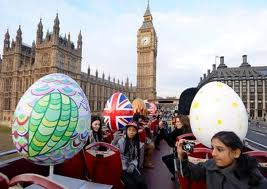
The Big Egg Hunt


Between 21st February and Easter weekend, you can take part in an Egg Hunt in London! Watch this video to find out more!

Can you answer these questions about the Big Egg Hunt?

1 How many eggs are there?

2 What is the name of the most expensive, special egg?

3 What's different about the Where's Wally Egg?

Now, visit this page and decide which egg you would like to find or buy! (Unfortunately, some of them, like the Egg Letter Box are already sold. :·C )

http://www.thebigegghunt.co.uk/eggs

Key
1 There are 209 eggs in the hunt, plus the prize egg.
2 The Diamond Jubilee Egg
3 The Where's Wally Egg will not be in one place all the time - it's the roaming egg.

New York


Watch the video and answer the questions below

1. What is Broadway Avenue?
2. Where is Times Square?
3. Why is it called Times Square?
4. How tall is the Chrysler Building?
5. How big is Central Park?
6. What can you see at Lincoln Center?
7. Name two museums near Central Park
8. What is the 5th Avenue famous for?
9. How many buildings are there in Rockefeller Center?
10. What style is St. Patrick’s Cathedral?
11. Which religion?
12. How many floors does the Empire State Building have?
13. When was it built?
14. What is Madison Square Garden used for?
15. What colour are the taxis in New York?
16. What’s the name of the castle in Battery Park?
17. Who was the first president of the United States?
18. What used to be in Ground Zero?
19. Which animal can you see in the financial district?
20. The Brooklyn Bridge goes from…………………… to …………………
21. When was it completed?
22. How much did it cost to cross it?
23. Where was the federal immigration station?
24. Name two neighbourhoods in Manhattan.
25. Where do people usually go in the evenings in Manhattan?

KEY

1. One of the longest roads in Manhattan
2. Broadway and 42nd street
3. Because the New York Times newspaper used to be there.
4. It’s 1048 feet.
5. 840 acres
6. operas and concerts
7. Natural History Museum and Metropolitan Museum
8. For the expensive brand name shops.
9. 19
10. Gothic
11. Catholic
12. 86
13. 1932
14. Shows, sport events, awards ceremonies
15. Yellow
16. Clinton Castle
17. George Washington
18. The World Trade Center
19. A bull
20. Manhattan to Brooklyn
21. in 1883
22. 1 penny
23. Ellis Island
24. Chinatown, Little Italy
25. Broadway