Mostrando entradas con la etiqueta Education. Mostrar todas las entradas

miƩrcoles, 2 de marzo de 2016

The Cosmic Classroom Video


Watch the first 8'50 minutes of the video and answer these questions:

1  Which things do you see Tim do?

2  Which two questions do the children ask Tim?

3  What are Tim's answers to these questions?

4  What is beautiful about Africa from space?


Key:
1  He crouches down and spins around and touches his toes.

2  What can you see out of your windows?   Why doesn't space have any gravity?

3  He can see the Atlantic Ocean and the coast of Africa.
Space does in fact have gravity but the spaceship moves so fast that it doesn't hit earth.

4  The desert areas - the Sahara Desert - and the beautiful colours.

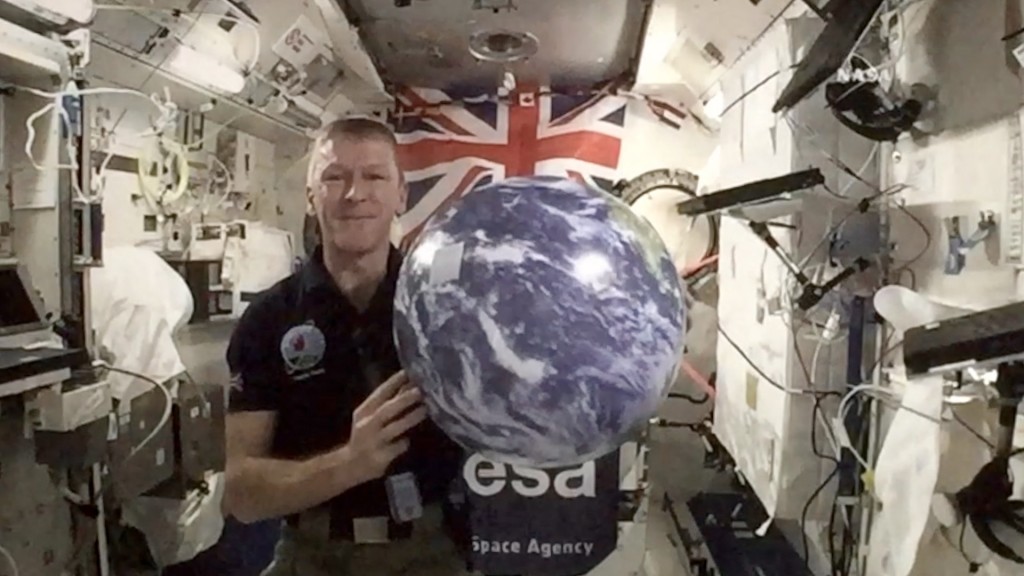
Astronaut Tim Peake's live TES #CosmicClassroom thrills hundreds of thousands of school pupils


http://ynuk.tv/wp-content/uploads/2016/02/Tim-explains-gravity-on-ISS-e1454466764846.jpg
British astronaut Tim Peake inspired hundreds of thousands of school pupils today as he spoke to them live from the International Space Station.
“Just do what you really enjoy doing,” Major Peake told students as he demonstrated how serious science could also be lots of fun.
During the 20-minute lesson,  Major Peake crouched down, spun around and touched his toes in order to demonstrate that without gravity it is much harder to stop moving and much easier to do somersaults.
 “We are so privileged to get to work up here,” he said. “It is like playing in a playground of weightlessness.”
Major Peake also answered some of the 7,000 questions which were submitted by school children, including whether his heart was beating faster (it actually beats slower because it has to work less hard), what his favourite button was (the one which opens the air lock to outer space) and whether it was fun to drink water bubbles (yes, a lot of fun). Tim Peake explained that the space station was hit all the time by small particles, but if anything larger was spotted the craft moved course.
At the World Museum in Liverpool, pupils from 12 schools around Britain took part in workshops ranging from "training like an astronaut" to modelling planets.
After the workshops, the pupils gathered to watch Kevin Fong – space medicine scientist and television personality – host the live link-up on a giant screen.
Dr Fong told TES why he thought space held such a fascination for children. “Space is about their future,” he said. “It gives them a sense that anything is possible, which is really what you want to encourage children to think.”
The Cosmic Classroom was watched by an estimated 300,000 students, in more than 10,000 schools.  Schools in the USA, Australia, the Philippines, Egypt, India, Pakistan and China were among those registered. But no registration was required to watch the broadcast, which was open to all.

Question 1 (2 points)  Indicate whether the following statements are true or false and write down which part of the text justifies your answer.
a.  Tim Peake went to visit students in British schools today.
b.  It is difficult to keep still in space.
c.   All the students at the World Museum were from schools in Liverpool.
d.   Everyone could watch the Cosmic Classroom for free.

Question 2 (2 points)  Answer the following questions in your own words.
a.   What were Major Peake’s answers to the questions about his heart and the water bubbles?
b.   Who is Dr Kevin Fong?

Question 3 (1·5 points)  Find words or phrases in the text that correspond in meaning to the words and definitions given.
a.  turn round very fast  (para. 3)  b. see (para.5)  c.  change direction (para. 5)
d. huge  (para. 7)   e.  show, programme (para. 9)

Question 4   (1·5 points)  Complete the following sentences without changing the meaning.
a. “Space is about their future,” Kevin Fong said. “It gives them a sense that anything is possible, which is really what you want to encourage children to think.”
Kevin Fong said that ……
b. British astronaut Tim Peake inspired hundreds of thousands of school pupils today.
Hundreds of thousands………….
c. The Cosmic Classroom was watched by an estimated 300,000 students, in more than 10,000 schools.
An estimated …

Question 5  (3 points)  Write a short essay (120-150 words) on the following topic:
Nowadays, we can learn in very different ways to the ways our parents did.

Key: Astronaut Tim Peake's live TES #CosmicClassroom thrills hundreds of thousands of school pupils

Question 1
a.  False. British astronaut Tim Peake inspired hundreds of thousands of school pupils today as he spoke to them live from the International Space Station.
b.  True.    … without gravity it is much harder to stop moving
c.  False.   At the World Museum in Liverpool, pupils from 12 schools around Britain took part in workshops…
d.  True. no registration was required to watch the broadcast, which was open to all.

Question 2   
a.  He said that his heart pumps less quickly because it does not have to make such an effort and that he really enjoyed drinking water bubbles.
b.   Dr Fong is a famous person who appears on TV and is also an expert in space medicine.
 
Question 3    a.  spin/spun   b.  spot/spotted   c. move/moved course   d.  giant   e.  broadcast

Question 4
a.  Kevin Fong said that Space was about their future. It gave them a sense that anything was/is possible, which was really what you wanted to encourage children to think.
b. Hundreds of thousands of school pupils were inspired today by British astronaut Tim Peake.

c.  An estimated 300,000 students, in more than 10,000 schools watched The Cosmic Classroom.

martes, 7 de mayo de 2013

Head warns over 'bunfight' for places at top schools


Parents are forcing their children to commute for up to 10 hours a week to get into the most sought-after private schools in Britain, a head teacher warned today.

Jane Grubb, headmistress of Bedales prep school in Hampshire, said children were being required to travel long distances – or drilled for months to pass entrance exams – when they should be spending time enjoying themselves.  Tutoring is increasingly popular in preparation for the 11-plus and Common Entrance – the traditional entry exams for state grammar schools and private senior schools.

One study last year suggested almost half of families in some parts of the country paid for private tutors to prepare sons and daughters for school entrance tests.
Mrs Grubb, the head of Dunhurst – the prep school attached to Bedales senior school – said that many parents were also prepared to send their children on lengthy commutes to secure places at some establishments.

Speaking to the Evening Standard, she said: “It starts when children are as young as eight. By the time they get to 10 they are spending two terms doing old exam papers to try to get into these places.  “Parents genuinely want them to be happy but they need to put their heads up and see what other life there is. The 10 hours they spend commuting could be spent getting more sleep or seeing their friends.”

Question 1. Indicate whether these sentences are true or false. Justify your answers with evidence from the text.
a) Children are being obliged to travel long distances to certain schools.
b) Children are advised to have more time for themselves.
c) In some areas parents often pay for private lessons.
d) Parents are believed to be doing the right thing.

Question 2. Answer the following questions in your own words.
a) What are the children requested to do by their parents to attend some schools?
b) What is the opinion of the people who are against?

Question 3. Find a word or a phrase in the text that means the same as:
a) to travel par. 1
b) to train par. 2
c) to guarantee par. 4
Question 4. Rewrite the following sentences without changing the meaning.
a) Children were being required to travel long distances.
            Parents...
b) Parents send their children on lengthy commutes to secure places at some establishments.
            If parents...
c)  She said: “It starts when children are as young as eight”
            She said that..

Question 5. Write a short essay (120-150 words) on the following topic:
            Are children nowadays doing too many extra curricular activities?

martes, 9 de abril de 2013

Textbooks

Heavy, expensive course textbooks are the bane of students' backs and bank accounts – but will they be around for much longer’, asks Andrew Marszal.
According to researchers at the University of East London there is still a clear correlation between spending on course books and your degree grade.
Last month they published a paper revealing that those who obtained a first-class degree spent an average £239 on books, while those with a 2:2 averaged only £179. Students leaving with a third had shelled out just £146.
But textbooks are expensive. So what are the alternatives?
University libraries – generally free to borrow from – are perfect. However, they are unlikely to stock enough copies of the most essential reading to keep everyone happy.
Another option is to sell or indeed buy in the second-hand market. This is cheaper, greener and you don’t need to worry about folding the page corners.
One growing alternative is to buy or rent textbooks online. CourseSmart, set up to help students and universities access course materials on their digital devices, launched in North America in 2006. It currently has 3.3 million student and staff users, and launched in the UK last month.
So could this really be the start of a digital textbook revolution?
“In the consumer world we don’t expect to ever reach 100 per cent digital,” says Fionnuala Duggan, Managing Director of CourseSmart. “ But as digital becomes better and better, there will come a point where it is impossible for students to prefer physical – we will see more interaction, more multimedia, video and integration with homework tasks, which will make learning from a physical book simply impractical.”
Not all agree. Mehdi Maghsoodnia of BookRenter.com, which specialises in renting physical textbooks, told a newspaper earlier this year that 99 per cent of the educational market still use physical texts. “To help students, you have to lower the cost of textbooks,” he said.


Question 1. Indicate whether these sentences are true or false. Justify your answers with evidence from the text.

a) The more you spend on books the better marks you get.
b) University libraries offer more copies than students demand.
c) You need not be careful with second hand books.
d) Going digital will change the way students do their tasks.

Question 2. Answer the following questions in your own words.

a) What are the main advantages of buying second hand books?
b) What is CourseSmart?

Question 3. Find a word or a phrase in the text that means the same as:
a)         improbable par. 5
b)         created par.7
c)         mechanism, piece of machine par. 7

Question 4. Rewrite the following sentences without changing the meaning.
a) Last month they published a paper revealing that those who obtained a first-class degree spent an average £239 on books.
A paper………………………………………..

b) In the consumer world we don’t expect to ever reach 100 per cent digital
100 per cent digital is………………………..
c) Mehdi Maghsoodnia said “To help students, you have to lower the cost of textbooks”
Mehdi Maghsoodnia said that …………………………..

Question 5. Write a short essay (120-150 words) on the following topic:
Will digital information take the place of the traditional way of being informed?

martes, 19 de marzo de 2013

Schools Ask: Gifted or Just Well-Prepared?


Ozier Muhammad/The New York Times
Natalie Viderman, 4, was tutored at Bright Kids NYC for an assessment test. 
Assessing students has always been a fraught process, especially 4-year-olds who are vying for increasingly precious seats in kindergarten gifted programs.  In New York, it has now become an endless contest in which administrators seeking authentic measures of intelligence find it difficult to keep ahead of companies who aim to bring out the genius in every young child.

The city’s leading private schools are even considering doing away with the test they have used for decades, popularly known as the E.R.B..

For the 2012-13 school year, nearly 5,000 children qualified for gifted and talented kindergarten seats in New York City public schools. That was more than double the number five years ago. Last year, the Education Department said it would change one of the tests used for admission to public school gifted kindergarten and first-grade classes and focus more on cognitive ability.  Test prep companies leapt to action, printing new books tailored to the new test and organizing classes.

Natalie Viderman, 4, spent an hour and a half each week for six months at Bright Kids NYC, a tutoring company, working on skills like spatial visualization and serial reasoning, which are part of the new test. She and her mother, Victoria Preys, also worked every night on general learning, test prep and workbooks.

“It is my philosophy that if you can get more help, why not?” Ms. Preys said. She prepared her son the same way and he benefited, she said.
“Every time these tests change, there’s a lot of demand,” Bige Doruk of Bright Kids, said. She said she did not accept the argument that admissions tests had been invalidated by test prep. “Parents will always do what they can for their children,” she said.  And not all children who take preparation courses do well, she said.

http://www.nytimes.com/2013/02/18/nyregion/new-york-city-schools-struggle-to-separate-the-gifted-from-the-just-well-prepared.html?smid=pl-share&_r=0


Question 1. Indicate whether these sentences are true or false. Justify your answers with evidence from the text.
a)  The E.R.B is a new test.
b) The number of children in New York who pass the gifted public school tests rose by 50% in just one year.
c)  Victoria was taught only by her mother.
d)  Tutoring companies have more work when the authorities modify their tests.

Question 2. Answer the following questions in your own words.
a)       What different ways of preparing children for the tests are mentioned?
b)       How does Ms Preys react to the criticisms made of people who prepare young children for the tests?

Question 3. Find a word or a phrase in the text that means the same as:
a) to complete (para. 1)
b) designed for (para. 3)
c) logic (para.3)

Question 4. Rewrite the following sentences without changing the meaning.
a) “It is my philosophy that if you can get more help, why not?” Ms. Preys said.
      Ms. Preys said that it …………….
b)   Administrators seeking authentic measures of intelligence find it difficult to keep ahead of companies who aim to bring out the genius in every young child.
      Although administrators try to keep ahead ……….., they …………………. do so.
c) The city’s leading private schools are even considering doing away with the test they have used for decades.
     Doing away with the test which   ……………………….... is even ……………………

Question 5. Write a short essay (120-150 words) on the following topic:
“Exams are the best way to test someone’s knowledge.”  Discuss.

martes, 5 de marzo de 2013

Parents failing to make children 'bully-proof', head warns


Many families are failing to “bully-proof” their sons and daughters by constantly allowing them to be “centre-stage” instead of promoting independence, self-confidence and resilience, it was claimed.
“Children are being seen as victims instead of being taught to stand up for themselves,” Peter Tait, a leading headmaster, warned.

In a provocative article published in Attain, the magazine for the Independent Association of Prep Schools, Peter Tait, the head of Sherborne Preparatory School in Dorset, admitted that modern pupils taunt their peers by text message and email. Some children have an “infinite capacity to invent new methods of cruelty”, he said.

In recent years, schools have been encouraged to develop detailed structures to log incidents, hold perpetrators to account and create pastoral systems to deal with pupils’ personal needs.

According to Government figures, half of children say they have been bullied at school at some point in their lives. Almost four-in-10 have been affected by cyber-bullying, it was revealed.

“Temporarily we can correct a problem, but what happens when the fault is at home, in the attitudes the children have inherited, in the excessive cosseting that has taken place, in how much the child has been allowed to be centre-stage?” Mr Tait said.


He added: “While schools may work hard on accommodating and celebrating difference amongst their pupils and teaching the right attitudes, children still need to learn appropriate values and strategies in order to cope when they leave school and encounter bullies in the workplace and communities.”


Question 1. Indicate whether these sentences are true or false. Justify your answers with evidence from the text.
a) Children are being prepared to face their own problems.
b) School are developing ways to control bullying.
c) Less than half of the children have been bullied online.
d) School days are important to form children for adulthood.


Question 2. Answer the following questions in your own words.
a) Why are families failing to help their children face bullying?
b) In what ways can schools fight back bullying?

Question 3. Find a word or a phrase in the text that means the same as:
a)       Persuade  (par. 3)
b)       manage (par. 3)
c)       get by  (par. 6)

Question 4. Rewrite the following sentences without changing the meaning.
a) Families are failing to “bully-proof” their sons and daughters by allowing them to be “centre-stage”.
            If families didn't...
b) Schools have been encouraged to develop detailed structures to log incidents.
            Authorities...
c)  “Half of children say they have been bullied at school at some point in their lives”, the Government said.
            The government said...

Question 5. Write a short essay (120-150 words) on the following topic:

Social networks are becoming a problem for some youngsters. Do you agree?

A third of parents struggle with primary school maths


            Nearly a third of parents of primary school children are 'scared' to help their kids with maths homework because they aren't confident in numeracy. In the ten-question test, a quarter of parents got a score of 4 out of 10 or less.

The poll of 2,000 parents of primary school pupils showed they found maths one of the toughest subjects to help their kids with, beaten only by French. The study was done by the educational publisher Pearson.

            When tested on ten primary-level maths questions, just 5% of parents got all ten answers correct.

            TV presenter maths whizz Carol Vorderman said: "Studies have shown that if parents help their children with homework they are more likely to succeed at school. "It is therefore worrying that so many parents lack confidence in their own maths skills."


Match the words below to their definitions

confidence / numeracy / presenter / publisher / pupils / succeed             

ability to do basic mathematics
students at school
company which prepares and prints books, newspapers or magazines
someone who introduces a radio or television programme
achieve what you are trying to achieve
when you are certain of your ability to do things well

True or false?

1.  Maths was the toughest subject for parents.
2.  Children do better at school if their parents help them.
3.  The test was given to 5% of parents in the UK.
4.  None of the parents got all the correct answers.
5.  The study was done by the government.
6.  Most of the parents got less than four questions right.
7.  Carol Vorderrman is good at maths.
8.  The results of the study are concerning.

What's the missing word?

1.  Just 5% of parents got all ten answers______________.
2.  They are more____________to succeed at school.
3.  They found maths one of the toughest____________.
4.  A quarter of parents got a____________of 4 out of 10 or less.


KEY

numeracy             ability to do basic mathematics
pupils                    students at school
publisher              company which prepares and prints books, newspapers or magazines
presenter              someone who introduces a radio or television programme
succeed               achieve what you are trying to achieve
confidence           when you are certain of your ability to do things well


True or false?

1. False
2. True
3. False
4. False
5. False
6. True
7. False
8. True

What's the missing word?

1. correct
2. likely
3. subject
4. score

martes, 3 de abril de 2012

University of Cambridge

University of CambridgeThe University of Cambridge is the second-oldest university in the English-speaking world (after Oxford).

It is situated in the town of Cambridge, England. According to legend, the university was founded in 1209 by scholars escaping from Oxford after a fight with locals there.

Cambridge has produced more Nobel prize winners than any other university in the world, having 80 associated with it, about 70 of whom were students there.

It regularly heads league tables ranking British universities, and a recent league table by the Times Higher Education Supplement rated it sixth in the world overall and first for science.

The universities of Oxford and Cambridge, often referred to together as Oxbridge, compete to be seen as the strongest overall university in the UK. Historically, they have produced a significant proportion of Britain's prominent scientists, writers and politicians.

Questions about the text

1. The University of Cambridge is the oldest university in England.
True.
False.
We don't know.

2. The University of Cambridge was founded by scholars from Oxford.
True.
False.
We don't know.

3. Many Nobel Prize winners were students at the University of Cambridge.
True.
False.
We don't know.

4. Many scientists, writers and politicians were students at the University of Oxford and the University of Cambridge.
True.
False.
We don't know.


KEY

False
True
True
True

martes, 20 de marzo de 2012

Physical book sales nosedive


The number of paperback books sold in the UK has slumped dramatically since Christmas thanks to the increasing popularity of e-readers such as the Kindle.

Sales of printed novels over the first four weeks of 2012 fell by over a million copies compared to the same month a year ago. The number of novels sold in January was just under four million, a decline of 25 per cent compared to January 2011.

Total book sales in the UK over the month – including non-fiction books such as cookbooks – fell by 12 per cent compared to January 2011.

Spending on printed, as opposed to electronic, books is now believed to be at the lowest level for almost a decade. The decline will heap pressure on traditional high street bookshops, which are already suffering due to the economic downturn and high rents.

The fall in sales of physical books has been attributed to the rapidly-growing popularity of Kindles and other e-readers, which display virtual books that are downloaded from the internet. A total of 1.33 million e-readers were sold in the UK over Christmas. This was double the amount sold the previous Christmas. Around one in 40 of all adults in the UK were given a Kindle over Christmas, making them far and away the most popular present in the country.

The trend of falling printed book is mirrored in other countries. According to Nielsen Book Scan, a company which tracks book sales, the number of printed books sold around the world is in steady decline. Jonathan Nowell, the company’s president, told a conference in Italy that the decline in sales of real books in the US has doubled over two years. Meanwhile sales of e-books have doubled every year for the last four years.

Italy is one of the few countries where fiction sales are still growing, according to The Bookseller magazine.

Glossary nosedive: caer en picado

Question 1. Indicate whether these sentences are true or false. Justify your answers with evidence from the text.

a) People bought a lot more novels in January last year than this year.
b) In the UK, only the sales of fiction books have dropped
c) Giving online reading devices as presents is becoming increasingly popular.
d) The fall in sales of printed books has only taken place in Europe.

Question 2. Answer the following questions in your own words.

a) Why are people buying fewer and fewer printed books?
b) How do e-readers work?

Question 3. Find a word or a phrase in the text that means the same as:

a) because of (par. 4) b) show (par.5) c) tendency (par.6)

Question 4. Rewrite the following sentences without changing the meaning.

a) Spending on printed books is now believed to be at the lowest level.
People ............................................................................................
b) "The decline in sales of real books in the US has doubled over two years while sales of e-books have doubled every year."
Jonathan Nowell said that .................................................
c) People buy fewer books because they download books from the internet.
If people.................................................

Question 5. Write a short essay (120-150 words) on the following topic:

What do you think about e-readers? Do you prefer printed books?

martes, 6 de marzo de 2012

University appoints world's youngest professor


Alia Sabur has astonished her parents and teachers for years with her exploits inside and outside the classroom. Now, the New Yorker has been named the world's youngest college professor ever, breaking a record set three centuries ago by a Scottish mathematician. Korea's Konkuk University has announced that Ms Sabur, 19, will begin teaching physics next month at the Department of Advanced Technology Fusion. The appointment, which was made a few days short of her 19th birthday on 22 February, earns the doctoral student a place in the Guinness Book of World Records ahead of Colin Maclaurin, a physicist who became professor of mathematics at the University of Aberdeen in 1717.

Few who know her were surprised at the announcement. University graduate at 10, bachelor's degree at 14, masters at 17; Ms Sabur has been "setting records and making history, starting with reading at eight months old", says her website (aliasabur.com). Along the way, she found time to become a concert clarinettist with the Rockland Symphony Orchestra when she was 11. She plays Mozart, but loves U2. "I went to their Vertigo concert," she says on the phone from New York. "It was awesome."

Ms Sabur, a PhD candidate in materials science and engineering, is developing spectroscopy techniques "including nano-tube-based cellular probes" that could be used to zap tumours – a cure for cancer, in other words. At university in the US, she worked with her professor on a cure for Alzheimer's disease.

What's her secret? Childlike curiosity, she says. She thanks God, and her mum and dad – a retired engineer and a cable television reporter – for her genius. "My parents encouraged me in anything I wanted to do. We believe it is a gift from God... a combination of gift and environment." The Guinness announcement has sparked a deluge of e-mails from curious parents. "They want advice for their kids. I say encourage them at what they're good at."

Question 1 [2 points]Indicate whether the following statements are true or false and write down which part of the text justifies your answer.
a) Alia was 18 when the Konkuk University made her a professor.
b) Alia was not impressed by U2’s concert.
c) Alia will be working on a project to cure Alzheimer’s Disease.
d) The Sabur family have received a lot of messages from other families.

Question 2 [2 points]Answer the following questions in your own words.
a) Who was the youngest university professor before Alia?
b) How does Alia explain her success?

Question 3 [1.5 points]Find words or phrases in the text that correspond in meaning to the words and definitions given.
a) achievements (paragraph 1)
b) destroy (paragraph 3)
c) to cause a reaction (paragraph 4)

Question 4(1.5 points]Complete the following sentences without changing the meaning.
a) Few people who knew Alia were surprised at the announcement.
The announcement ……………...............……… very many people who knew Alia.
b) “My parents encouraged me in anything I wanted to do. We believe it is a gift from God,” said Alia.
Alia said that ………...................... and that ……..................................…. .
c) Scottish mathematician Colin Maclaurin set the record of the world’s youngest professor three centuries ago.
Scottish mathematician Colin Maclaurin has been ………………......................…………… centuries.

Question 5[2 points]‘If you want to be successful, you have to work hard.’ Comment. Write 120 – 150 words.

martes, 28 de febrero de 2012

School grades hit by lack of routine


Research for the Prince's Trust suggests young people with poor exam grades are twice as likely to claim their days lacked structure as they grew up. In an online survey, 2,136 respondents aged between 16 and 25 were asked how happy and confident they are in different areas of their life. The responses were converted to a numerical scale, resulting in a number out of 100 – with 100 representing entirely happy or confident and zero being not at all happy or confident. Young people’s happiness has fallen to its lowest number of 70 in 2010 and their confidence has also fallen - from an overall score of 74 in 2008 to 71 in 2010.

Some 14% of all young people said they had grown up without set mealtimes, compared with 30% of young people with poor exam grades. The research also suggests that 27% of youngsters did not grow up with a set bedtime. This rose to 39% for those who left school with fewer than five good GCSEs.

The data comes from the charity's latest annual Youth Index, which looks at how young people feel about their lives across a range of areas from family life to physical health. It also suggested those who felt they "lacked structure and direction" while growing up also appeared to be less content and confident than their peers. One in three of those with lower qualifications (33%) said they "always" or "often" felt rejected, compared with about one in five young people (22%) overall.

Princes Trust chief executive Martina Milburn said: "The absence of structure and routine in a young life can have a devastating impact. "Without the right support, directionless teenagers can become lost young adults - unconfident, underqualified and unemployed."

Comments from readers of this article


I am a primary school teacher in an Inner City area. A large proportion of children have no breakfast before school, some even arrive not having had a drink. The same group of children look exhausted and quite often go to bed far later than I do. Unsurprisingly, these children don’t do so well. Yet the govt still expects these children to do as well as those in wealthier, more structured households!

What surprises me, is that this information should even be considered as a surprise to anyone. Of course children who have a well structured routine will do better in school. The presence of a routine denotes a stable family environment, which in turn lends itself to times set aside for homework, exam revision and education in general. A link between the two is hardly a groundbreaking discovery.

What is YOUR reaction to this survey and its results?

Do YOU have set mealtimes and bedtime?

Question 1. Indicate whether these sentences are true or false. Justify your answers with evidence from the text.
a) Only teenagers took part in the study.
b) Young people nowadays are not as happy as they were before.
c) The questions in the survey only asked about school.
d) Martina Milburn disagrees with the results of the survey.

Question 2. Answer the following questions in your own words.
a) What are the consequences of a lack of routine in young people’s lives?
b) How was the survey conducted?

Question 3. Find a word or a phrase in the text that means the same as:
a) total (par. 1) b) figures, information (par.3) c) effect (par.4)

Question 4. Rewrite the following sentences without changing the meaning.
a) Young people with poor exam grades are twice as likely to claim their days lacked structure as they grew up.
If young people’s days .....................................................................................
b) 14% of all young people said they had grown up without set mealtimes, whereas 30% of young people with poor exam grades answered that they had not eaten at regular times.
14% of young people said “I .................................................,” whereas 30% of those with poor exam grades answered “........................................”
c) First, 2,136 people between 16 and 25 were asked how happy and confident they were, then the responses were converted to a numerical scale.
After ................................................. , the researchers ……………..

Question 5. Write a short essay (120-150 words) on the following topic:
Having a regular daily routine is important for success.” What do you think?

martes, 24 de enero de 2012

Sir Paul McCartney attacks French school over vegetarian ban


Sir Paul McCartney has attacked the French Government for banning vegetarian meals in schools.
There will be no meat-free days in French schools for six million children following a new decree from their government that all students will have to eat meat if they want lunch at school. Taking a packed lunch is not an alternative as they are also banned.

The ban will shortly be extended to kindergartens, hospitals, prisons, colleges and old people's homes.

French agriculture minister, Bruno Lemaire, said in January that the Government's aim for nutrition was to defend the French agricultural model and counter initiatives such as those by vegetarian campaigners like Sir Paul – who has called for a reduced consumption of meat.

But writing on his website, Sir Paul said: "The French Government's recent decree effectively enforcing the consumption of animal products in public institutions is a backward step for France. It goes against the Charter of Fundamental Rights of the European Union by prohibiting individuals' right to express their beliefs.No one needs to eat animals – and we can combat climate change and lessen the risk of suffering from heart disease and other ailments by reducing the amount of meat we eat."
This week People for the Ethical Treatment of Animals (PETA) launched a new stamp range featuring the 20 most famous vegetarians of all-time, including the ex-Beatle. Sir Paul along with Natalie Portman, Pamela Anderson and Morrissey have agreed to feature on the stamp. The stamps can be purchased throughout December at www.peta.org
Source: telegraph.co.uk

Question 1. Indicate whether these sentences are true or false. Justify your answers with evidence from the text.

a) Students cannot take home-made lunches to school.
b) Currently there are no meat-free meals for people who are in prison. c) Sir Paul McCartney believes that the French Government’s decision does not respect people’s rights. D) According to McCartney, people who eat meat are more likely to suffer illnesses.

Question 2. Answer the following questions in your own words.

a) Why has Sir Paul McCartney reacted against the French Government?
b) What has PETA done about the ban?

Question 3. Find a word or a phrase in the text that means the same as:

a) soon (par.3) b) attenuate, decrease (par.5) c) buy (par.6)

Question 4. Rewrite the following sentences without changing the meaning.

a) The French Government has banned packed lunches.
Packed lunches ......................................................
b) " No one needs to eat animals and we can combat climate change.”
Sir Paul McCartney said that .................................................
c) Mr. Dahl suffered from heart disease because he ate too much meat.
If Mr Dahl .................................................

Question 5. Write a short essay (120-150 words) on the following topic:
What do you think about climate change? How can you help?